


Ring Camera: The Next Era of Home Security


The Next Era of Home Security
Introduction: The Paradigm Shift in Smart Security
For over a decade, Ring has been synonymous with the video doorbell, a device that fundamentally changed how homeowners interact with their front porches. However, as the smart home market matures, the demand for “simple connectivity” has been replaced by a demand for “intelligent protection.” The latest announcements from Ring, specifically the unveiling of the Retinal 4K infrastructure and the professional-grade Elite Series, represent a pivot from reactive recording to proactive, AI-driven intelligence.
This document explores the technical architecture, strategic implications, and practical applications of these new offerings, categorizing them into two primary pillars: the broader Ring ecosystem advancements and the specific, high-performance Ring Elite hardware line.
Part I: The Ring Announcements – Redefining the Ecosystem
The updates found at ring.com/announcements signal a shift in Ring’s philosophy. No longer content with 1080p resolution and basic motion zones, Ring is integrating edge computing and advanced AI to create a “thinking” security system.
1. Retinal 4K: Beyond Resolution

The move to “Retinal 4K” is not merely about increasing pixel count; it is about pixel density and clarity. Standard 4K in security cameras often suffers from compression artifacts that make it difficult to identify license plates or facial features at a distance. Ring’s Retinal 4K aims to provide a high-bitrate experience that ensures digital zooming does not result in a blurred image. This is critical for forensic evidence and for the AI models that must “see” details to accurately categorize events.
2. The Amazon Sidewalk Sensor Revolution
Historically, smart sensors required a dedicated hub or “Base Station” to communicate. This created a single point of failure and limited the range of sensors to the reach of the hub’s radio. The new line of Ring Sensors utilizes Amazon Sidewalk, a shared, low-bandwidth network that allows devices to connect over long distances using BLE (Bluetooth Low Energy) and LoRa (Long Range) frequencies.
-
Flexibility: These sensors can be placed at the far edges of a property—on a back gate, a detached shed, or a mailbox—without worrying about Wi-Fi dead zones.
-
Resilience: Because they don’t rely on a central base station, the failure of one bridge doesn’t take down the entire perimeter defense.
3. AI-Powered Insights: Intelligence at the Edge
The most significant leap forward lies in how Ring processes video data. Through advanced computer vision, Ring is moving toward a “zero-false-alert” goal.
A. Fire Watch
By training neural networks to recognize the specific visual signatures of smoke plumes and flickering flames, Ring’s outdoor cameras can now act as a first-alert system for environmental hazards. This is particularly vital in wildfire-prone areas where early detection can be the difference between a controlled incident and a total loss.
B. Unusual Event Alerts
Traditional motion detection is binary: something moved, or it didn’t. “Unusual Event Alerts” use machine learning to establish a baseline of “normalcy.” If the camera sees a car pull into the driveway at 5:00 PM every day, it stops notifying the user. However, if a person walks into the backyard at 3:00 AM—a deviation from the pattern—the system flags it as high priority.
C. Smart Video Search
Perhaps the most user-centric feature is Smart Video Search. Instead of scrolling through hours of “Motion Detected” clips, users can type natural language queries such as:
-
“Show me a brown dog in the front yard yesterday.”
-
“When did the delivery truck arrive?”
-
“Find clips of a person wearing a red jacket.” This transforms the Ring app from a video player into a searchable database of household activity.
4. The Ring Appstore: Security as a Platform
By opening an “Appstore,” Ring is inviting developers to create specialized software for their cameras. This creates vertical-specific utility:
-
Pet Wellness: Monitoring how often a dog drinks water or if it is pacing excessively.
-
Retail Intelligence: For small business owners, apps can track “dwell time” or “customer flow,” turning a security camera into a business analytics tool.
Part II: The Ring Elite Series – Peak Protection Hardware
While the software updates improve all devices, the Ring Elite Series represents the pinnacle of Ring’s hardware engineering. Designed for high-end residential and commercial applications, the Elite series moves away from the “single-lens” tradition into a multi-lens, panoramic ecosystem.
1. The Multi-Lens Panoramic Philosophy
Every device in the Elite line features a multi-lens array. This eliminates the “fisheye” distortion common in wide-angle lenses. By stitching multiple 4K feeds together in real-time, the Elite series provides a flat, high-resolution horizon that allows for 10x digital zoom without losing the context of the surrounding area.
2. Model Breakdown and Use Cases
A. Ring Elite 140
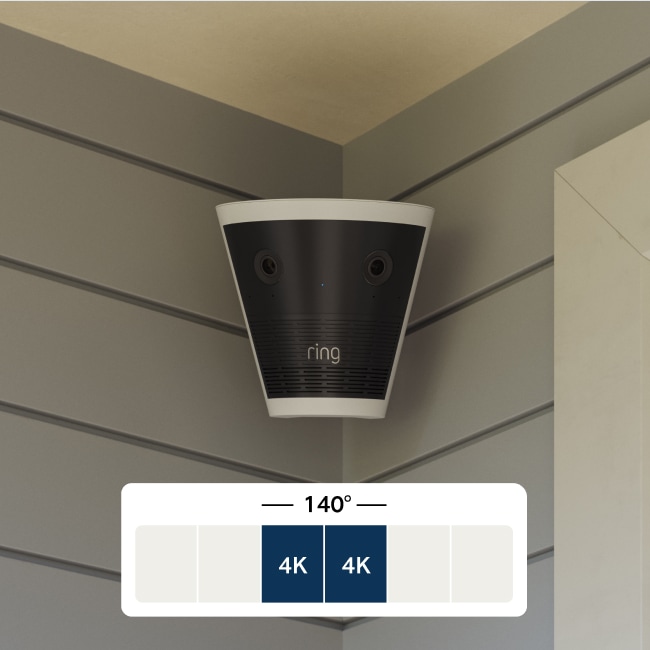
-
Design: Focused 140-degree field of view.
-
Primary Use: Entryways and internal corners.
-
Logic: This is the “surgical” tool of the line. It is intended for areas where high-detail facial recognition and package monitoring are the priority. It offers the highest pixel-per-foot ratio of the series.
B. Ring Elite 180
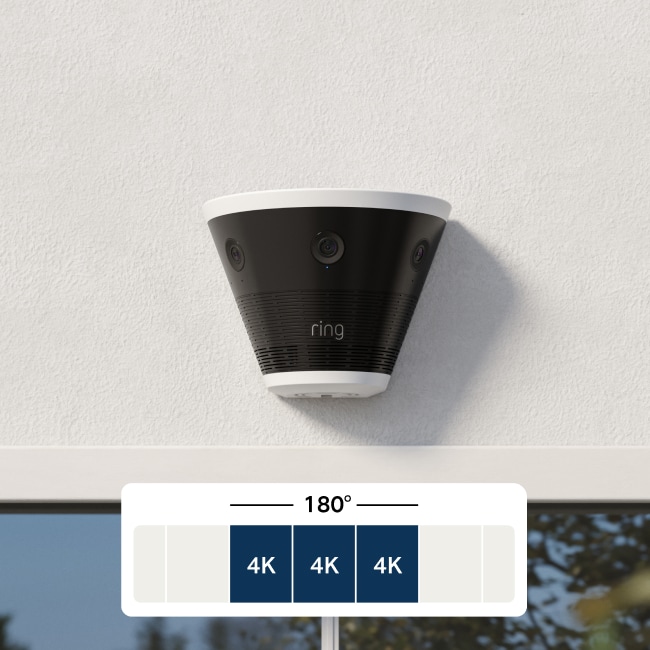
-
Design: A wall-mounted 180-degree panoramic view.
-
Primary Use: Yards, long corridors, and street-facing walls.
-
Logic: The 180 eliminates “blind spots” against the wall where the camera is mounted. It is the ideal replacement for a standard floodlight camera, providing a “wall-to-wall” view of a property line.
C. Ring Elite 270
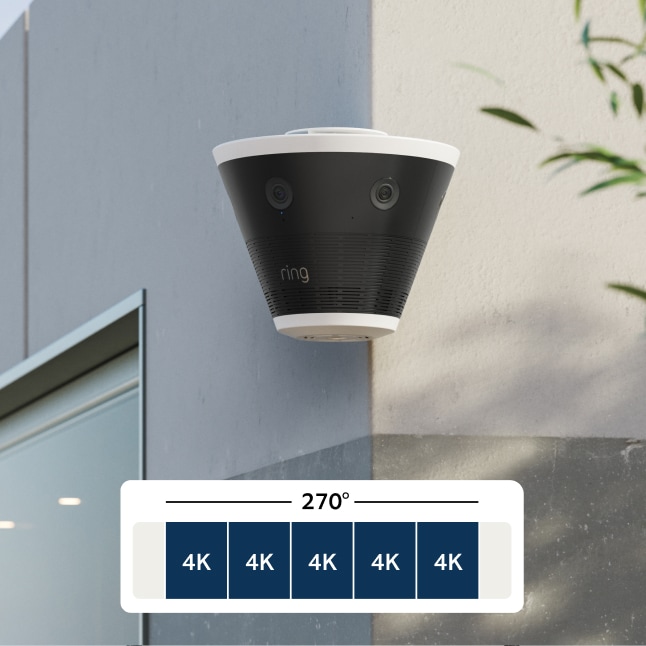
-
Design: Corner-mounted wrap-around view.
-
Primary Use: The exterior corners of buildings.
-
Logic: This is a revolutionary form factor. Traditionally, seeing around a corner required two cameras. The Elite 270 uses angled lenses to provide a continuous view of two sides of a building simultaneously, allowing a user to “track” a subject as they move around the structure without switching feeds.
D. Ring Elite 360
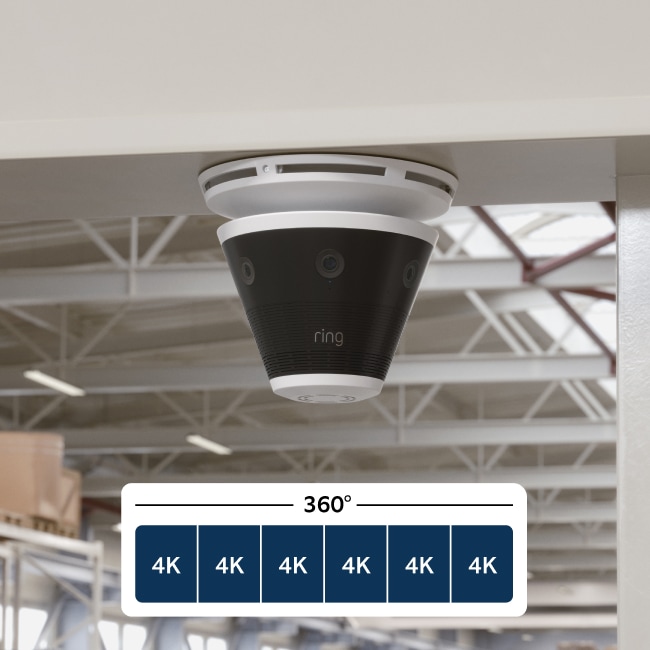
-
Design: Ceiling-mounted total immersion.
-
Primary Use: Large open rooms, warehouses, or mobile security trailers.
-
Logic: The 360 is the “Eye in the Sky.” When paired with the Ring Mobile Security Trailer, it becomes a commercial-grade solution for construction sites or event parking lots, providing a literal bird’s-eye view that can be monitored remotely.
Part III: Advanced Technical Features and User Experience
The Elite series is defined by how it handles the massive amount of data generated by 4K multi-lens arrays.
1. Panorama Control and Digital Zoom
Unlike static cameras, the Elite interface allows users to “glide” through the panoramic field. Because the source resolution is so high, the 10x digital zoom functions like a PTZ (Pan-Tilt-Zoom) camera but without the mechanical parts that can break or the lag of a moving motor.
2. Solving “Notification Fatigue”
A common complaint with smart cameras is the “ping” every time a leaf blows. Ring addresses this with two specific AI features:
-
AI Single Event Alerts: If a child is playing in the front yard for thirty minutes, a standard camera might send 50 alerts. The Elite AI recognizes this as one continuous “event” and groups the data into a single notification, updating the clip as the action continues.
-
AI Video Descriptions: Instead of a notification saying “Motion at Front Door,” the Elite series sends a text summary: “A person in a blue shirt is carrying a large box toward the porch.” This allows the user to triaged alerts without ever opening the app.
Part IV: Strategic Implications for the Security Industry
The launch of these products marks Ring’s transition from a consumer-electronics company to a serious competitor in the professional security space.
-
Challenging Traditional CCTV: With the Elite 270 and 360, Ring is moving into territory previously held by expensive, hard-wired NVR (Network Video Recorder) systems. By offering a cloud-native, AI-first alternative, they are simplifying the “Pro-sumer” install.
-
The Connectivity Play: By leveraging Amazon Sidewalk for sensors, Ring is creating a mesh network that is larger than any individual home’s Wi-Fi. This “neighborhood” level of connectivity strengthens the value of the Ring ecosystem.
-
Data as Utility: The Smart Video Search and Appstore signal that Ring believes the value of a camera isn’t just in the “recorded video,” but in the “searchable data.”
Conclusion
The innovations highlighted on ring.com/announcements and the ring-elite pages represent a holistic upgrade to the modern smart home. By combining the raw power of Retinal 4K and Multi-Lens Panoramic hardware with the sophisticated intelligence of AI Video Descriptions and Smart Search, Ring is attempting to solve the two biggest problems in home security: poor image quality and unmanageable notification volume.
Whether it is a homeowner looking for the focused protection of an Elite 140 or a business owner deploying a Mobile Security Trailer with an Elite 360, these tools represent the current “peak” of accessible, intelligent surveillance technology. As Ring continues to roll out these features, the expectation for what a “security camera” should do has been permanently raised.
Witnessing these changes firsthand at CES has allowed Guardian Angel Lock & Security to bridge the gap between “DIY” hardware and “Pro-Grade” installation. By combining 20+ years of locksmithing expertise with the latest in 4K AI technology, they ensure that your new Ring Elite system isn’t just a gadget—it’s a fortified defense.
- Closed-Circuit Television (CCTV)
- MUL-T-LOCK MT5+ High Security
- Mul-T-Lock 800 High Security
- Mul-T-Lock Grade 1 Deadbolt
- Intercom Systems
- Safes
- Commercial Door Hardware
- Rekeying / Cylinder Combination Change
- Electric Strikes
- Magnetic Locks
- Panic Devices
- ButterflyMX Access Control
- DoorBird Multi-Tenant Intercom
- DoorKing Multi-Tenant Intercom


